

In the realm of modern construction, the adoption of Building Information Modeling (BIM) has become synonymous with innovation and efficiency. However, navigating the complexities of BIM can be daunting, especially for those new to the concept. One of the fundamental concepts to grasp is the “Levels of BIM,” a framework that defines the depth of digital collaboration and information exchange throughout the project lifecycle. In this blog post, we’ll delve into the various levels of BIM, demystifying their significance and shedding light on their practical applications.
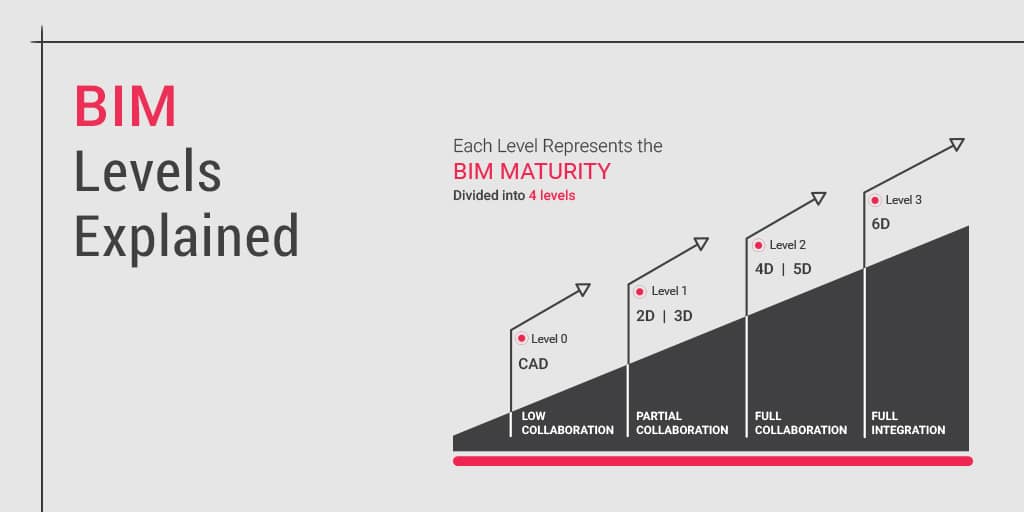
Level 0: Non-Existent BIM
At Level 0, BIM is virtually non-existent. This traditional approach to construction relies primarily on 2D drawings and documentation, with minimal if any, digital collaboration. Each stakeholder works independently, often leading to information silos, inefficiencies, and potential errors. While Level 0 may still be prevalent in certain segments of the industry, its limitations are increasingly evident in today’s fast-paced construction environment.
Level 1: 2D/3D CAD BIM
Level 1 marks the entry point into the world of BIM, where basic digital modeling capabilities are introduced. Stakeholders utilize 2D or 3D Computer-Aided Design (CAD) software to create digital representations of building components. While this represents a step forward from traditional methods, collaboration remains limited, with minimal integration between disciplines. Each stakeholder manages their own digital models independently, resulting in disjointed workflows and potential inconsistencies.
Level 2: Collaborative BIM
Level 2 represents a significant advancement in digital collaboration within the construction industry. At this level, stakeholders work collaboratively within a shared BIM environment, utilizing a common data format such as Industry Foundation Classes (IFC). Each discipline maintains its own model, but these models are federated into a single, coordinated model, enabling clash detection, coordination, and collaboration across disciplines. Level 2 BIM facilitates improved communication, reduced errors, and enhanced project coordination, laying the foundation for more efficient project delivery.
Level 3: Integrated BIM
Level 3 represents the pinnacle of digital collaboration and integration within the construction industry. At this level, stakeholders go beyond mere coordination and begin to fully integrate their processes and data within a Common Data Environment (CDE). All project information, from design and construction to facility management, is stored and managed in a centralized digital repository, accessible to all authorized parties in real-time. Level 3 BIM enables seamless information exchange, enhanced decision-making, and improved project outcomes throughout the entire lifecycle of the building.
Practical Applications and Benefits
Understanding the levels of BIM is crucial for stakeholders to gauge their current capabilities and chart a path towards greater digital maturity. By embracing higher levels of BIM, construction projects can realize a myriad of benefits, including:
- Improved collaboration and communication among stakeholders.
- Reduced errors, clashes, and rework through enhanced coordination.
- Streamlined project delivery timelines and increased efficiency.
- Enhanced facility management and asset performance over the building lifecycle.
- Greater resilience, sustainability, and cost-effectiveness of built assets.
Conclusion
As the construction industry continues to embrace digital transformation, the levels of BIM serve as a roadmap for stakeholders seeking to harness the full potential of technology to deliver better buildings, faster and more efficiently. By understanding the progression from non-existent BIM to integrated BIM, stakeholders can make informed decisions, adopt appropriate technologies, and drive positive change within their organizations. In an increasingly competitive and dynamic market, embracing BIM is not just an option—it’s a necessity for success in the digital age of construction.
