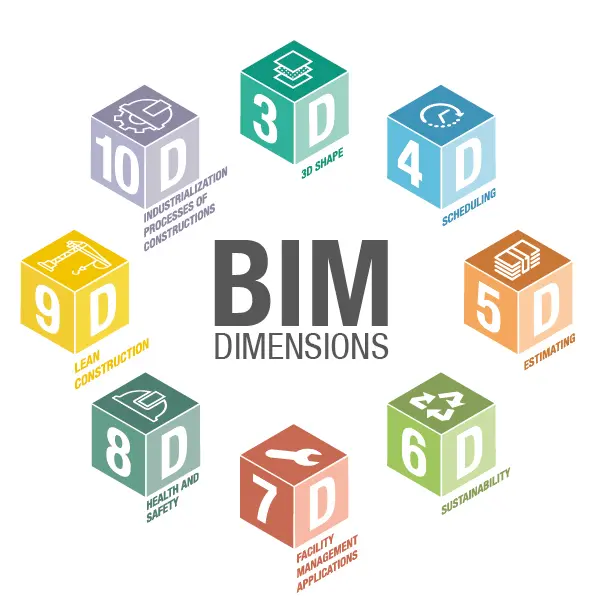

Building Information Modelling (BIM) encompasses multiple dimensions, each playing a crucial role in the construction and management of projects. Let’s explore these dimensions: 🔍
1D BIM involves processes, legalities, contracts, and the mandated use of BIM in public projects, prompting changes in recruitment models and setting new requirements.
2D BIM is the transition from 3D models to 2D drawings, focusing on workflow implementation, data acquisition, and cost-effective implementation strategies.
3D BIM revolves around creating and sharing 3D models in a Common Data Environment (CDE), facilitating seamless collaboration among multidisciplinary teams.
4D BIM integrates scheduling information into the model, allowing project teams to track progress across phases and ensuring adherence to project timelines.
5D BIM involves cost estimation, enabling precise cost data extraction from the model, and continuous budget monitoring and analysis throughout the project.
6D BIM concentrates on facility management, providing insights for optimal maintenance and operational decisions throughout the project’s life cycle.
7D BIM emphasizes sustainability by enabling energy simulations, resource optimization, and compliance with environmental certification protocols.
8D BIM deals with safety aspects, aiding in risk analysis and safety documentation during the construction, usage, and maintenance phases.
9D BIM incorporates Lean Construction methodologies, ensuring effective BIM completion within the construction sector’s production structure.
10D BIM focuses on Industrialized Construction, employing Lean principles within a BIM environment to enhance productivity across design, implementation, and management phases.
Industrialized construction aims to boost efficiency by streamlining processes, reducing waste, and harnessing technology and digitalization for enhanced productivity.
Overall, BIM’s diverse dimensions demonstrate its potential to revolutionize construction by employing collaborative, data-driven approaches throughout the project life cycle.